- Home
- Canvas Guide
Partial Progress - Circles (browser only)
Equivalent Fractions
Objectives
To understand that although some fractions contain different numbers, they can represent the same amount of a shape or number.
Resources
Abacus 4 Textbook 2 | Equal-sized pieces of paper | Squared paper | Assignment 4
Today's Lesson
Main Activity
Using equal-sized pieces of paper, cut one piece into ½ s (halves), another piece into ¼ s (quarters), another into 1/8 s (eighths) and another into 1/16 s (sixteenths). Ask your student some questions such as, how many quarters make a half, how many eighths make a half, how many eighths make a quarter, how many sixteenths make a half, and so on.
 Once your student has understood the concept - that different numbers of different sized pieces are equivalent to the same sized piece of paper, turn to page 28 in Abacus 4 Textbook 2.
Look at the page with your student. Please note, in the diagram, chocolate bar ‘a’ is not a very helpful size. The calculation will be easier if it is redrawn 8 squares long, not 6, as in the diagram. Ask your student to draw an 8 x 4 rectangle on the squared paper and to work from this.
Look at the questions one by one and ask your student to follow the instructions.
If necessary, use more pieces of cut up paper, to help instill the concept of same size, but different numbered fractions.
Using a fraction wall is another way to look at equivalent fractions.
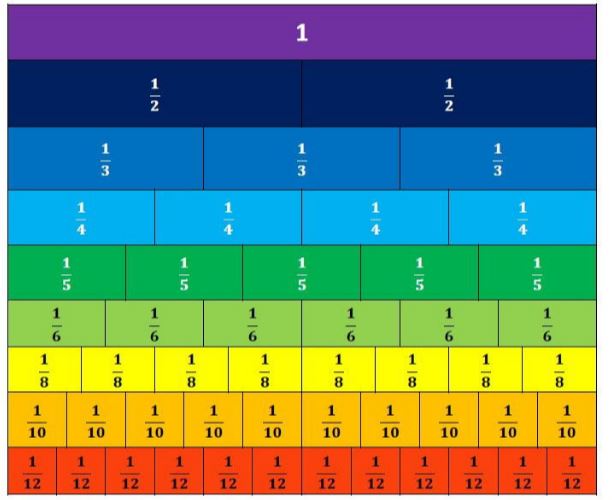
Now complete Assignment 4.