- Home
- Canvas Guide
Partial Progress - Circles (browser only)
Fractions of Shapes
Objectives
To find halves, quarters and thirds of shapes by folding.
Resources
Abacus Workbook 3 | Pieces of A4 paper | 📄 Square and circle | 📄 Shapes divided into two, three or four parts | 📄 Quarters and thirds (two copies)
Vocabulary
half | quarter | third
Today's Lesson
What to Get Ready
 Print and cut out the 📄 Square and circle.
Optional: You might like to have some different shapes of paper ready to work with during the introduction video: square, rectangle, circle, triangle, heart, hexagon. However, this is not essential, and the video can be used without the paper if needed.
Introduction
This video gives an introduction to finding halves, quarters and thirds of shapes.
Fold an A4 sheet in half, and then open it out again.
Ask: ‘What have you done to the paper? What do we call each part?’
Remind your student how we write this. Write ‘half’ on the board and \begin{matrix}\frac{1}{2}\end{matrix}on each part of the paper.
Ask: ‘How many \begin{matrix}\frac{1}{2}\end{matrix}s make a whole?’
Now fold an identical piece of paper into quarters, by folding it in \begin{matrix}\frac{1}{2}\end{matrix}and \begin{matrix}\frac{1}{2}\end{matrix}again.
Explain: ‘I’ve folded this piece of paper into 4 equal parts. We call these quarters.’
Write the word on the board and \begin{matrix}\frac{1}{4}\end{matrix}on each section of the paper.
Ask: 'How many \begin{matrix}\frac{1}{4}\end{matrix}s make a whole? How many \begin{matrix}\frac{1}{4}\end{matrix}make one half?'
Give your student a 📄 Square and a circle and ask them to fold their shape in \begin{matrix}\frac{1}{2}\end{matrix}and then \begin{matrix}\frac{1}{2}\end{matrix}again.
Explain that this is a good way to make sure that each part is the same size.
Discuss how the \begin{matrix}\frac{1}{4}\end{matrix}s of the circles and the squares look different.
Show a square folded in \begin{matrix}\frac{1}{2}\end{matrix}along a diagonal. Is this shape folded in \begin{matrix}\frac{1}{2}\end{matrix}? How do you know?
Fold again to show \begin{matrix}\frac{1}{4}\end{matrix}s.
Now fold a piece of A4 paper into thirds. Show how you tuck one end in under the other as you fold the two ends together.
Say: ‘It takes a bit of toing and froing to ensure the sections are equal.’
Write the word ‘third’ on the board and \begin{matrix}\frac{1}{3}\end{matrix} on each section of the paper.
Show a piece of paper not equally folded in half and open it out. Has this piece of paper been folded in half? Point out that if you tore the piece of paper along this fold and shared it between two people, it wouldn’t be fair. One person would have a bigger piece than the other.
Repeat, folding into four unequal parts and three unequal parts, pointing out that these are not quarters or thirds.
Main Activity
Access 📄 Shapes divided into two, three or four parts and ask your student to ‘tick’ or ‘cross’ the shapes, according to whether they are correctly divided into halves or quarters or thirds.
They can use a red pencil to correct them!
Then, complete the following task:
- Work as a pair. On your own sheet, each of you ‘secretly’ colour
\begin{matrix}\frac{3}{4}\end{matrix}of the first square on the 📄 Quarters and thirds, using between 1 and 3 different colours. - Describe how you have coloured it to each other, then the other person tries to colour their second square to match their partner’s.
- Swap back and repeat with the next pair of squares.
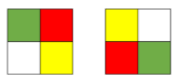
Ask: ‘How many ways are there to colour \begin{matrix}\frac{3}{4}\end{matrix}green? How many squares could be just one color? Are these two squares shaded in the same way?’
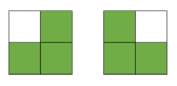
Ask: ‘How about these?’
Workbook
 To help your student build upon their learning from today, please ask them to complete the activities on page 21 of Abacus Workbook 3.