"I would suggest that parents should not be afraid to change the daily tasks if you want to, as long as the outcome is the same."
Wolsey Hall parent
Timetables
When you are enrolled on a Wolsey Hall course, you will receive a timetable like the one shown below. This provides an overview of the number of lessons within a week and when assignment work will be completed.
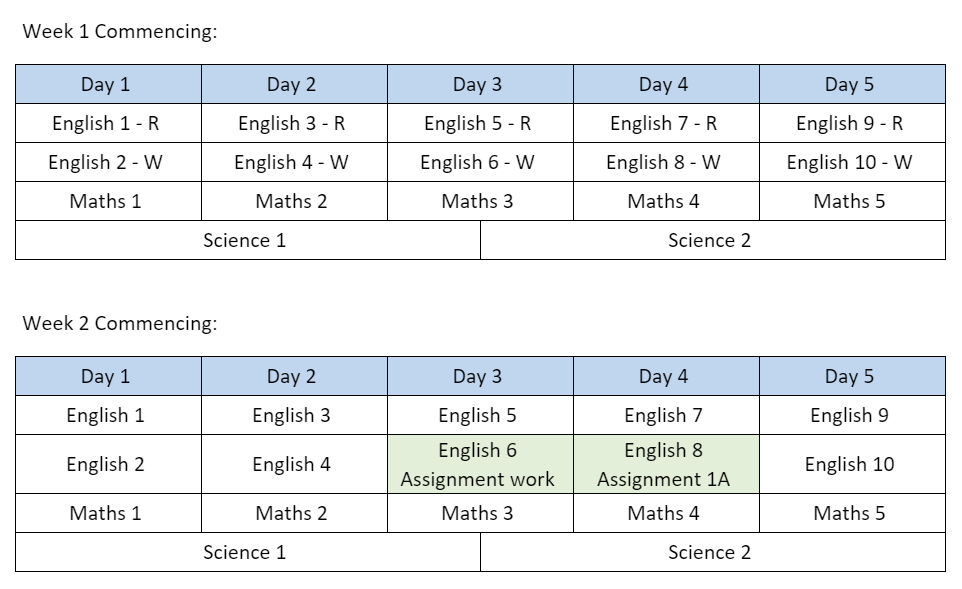
Key for the timetables:
- The numbers indicate lesson number eg. English 1 = English lesson 1
- R = reading
- W = writing
- Assignment = the work completed by your child that is submitted to your tutor for checking and next step in learning.
Here are links to editable timetables which can be downloaded and adapted to suit your own schedules. Please note that subjects may need to be added or removed from the templates, depending on your child's chosen subjects.
Lower Primary Timetables (Years 1 and 2)
📝 Editable Part 1 Lower Primary Timetable
📝 Editable Part 2 Lower Primary Timetable
📝 Editable Part 3 Lower Primary Timetable
Upper Primary Timetables (Years 3, 4, 5 and 6)
📝 Editable Part 1 Upper Primary Timetable
📝 Editable Part 2 Upper Primary Timetable
📝 Editable Part 3 Upper Primary Timetable
Planning your time
When planning your learning time, you should consider what times of the day your child is most motivated. This time is often earlier in the day but will vary for each child.
TIP 1 (audio clip):
TIP 2 (audio clip):
"It is important to be well prepared for the lesson, as certain subjects require items that you may not always have with you, for example, Art and Science. It is also important that as a parent you have the time to commit to your child's lessons to ensure that they gain the most from their lessons."
Wolsey Hall parent
TIP 3 (audio clip):
Focus, concentration and breaks
As adults, we can often overestimate the length of time a child can focus on a learning task. A five-year-old child on average can concentrate on a single task for ten minutes, however, a ten-year-old child may be able to concentrate for up to 30 minutes. Be aware that children's concentration spans vary greatly, and you will get to know how long your child can focus as they move through the courses, before needing a break.
Our lessons are designed to be split into smaller chunks of learning which allows you to build regular breaks into your child's learning routine. Even a small break can help to bring their concentration level back to its peak.
Find our more about brain breaks

Citations
[1] www.twinkl.co.uk